



Mini Relógio Matriz de LED – Arduino Nano
Componentes e Materiais
| Componente | Quantidade |
|---|---|
| Arduino Nano R3 | 1 |
| Maxim Integrated DS3231M - ±5ppm, I2C Real-Time Clock | 1 |
| Chave Pushbutton Momentânea | 2 |
| Módulo Matriz LED 32x8 (MAX7219) | 1 |
Ferramentas Necessárias
- Ferro de solda (genérico)
Aplicativos e Serviços Online
- Arduino IDE
Sobre o Projeto
Na página "Nick's LED Projects" encontrei um projeto de relógio que mostra a hora em 4 matrizes de 8x8 LEDs. Ele construiu o relógio com matrizes da loja "ICStation" que vende kits DIY de painel de matriz.
Com uma mudança mínima no código, fiz meu relógio com módulo de matriz de pontos MAX7219 quatro-em-um 32x8 que é completamente dobrado e muito mais barato. Comprei no AliExpress.
O relógio tem muitas funcionalidades:
- Modo básico com dígitos grandes
- Modo deslizante onde dígitos rolam na tela
- Modo dígitos pequenos com segundos
- Hora escrita por extenso, ex: "dez para o meio-dia"
- Exibição de data
- Opção 12/24 horas
- Opção de brilho
- Modo relógio aleatório que muda o modo de exibição a cada poucas horas
- Menus controlados por botões para configuração e seleção de exibição

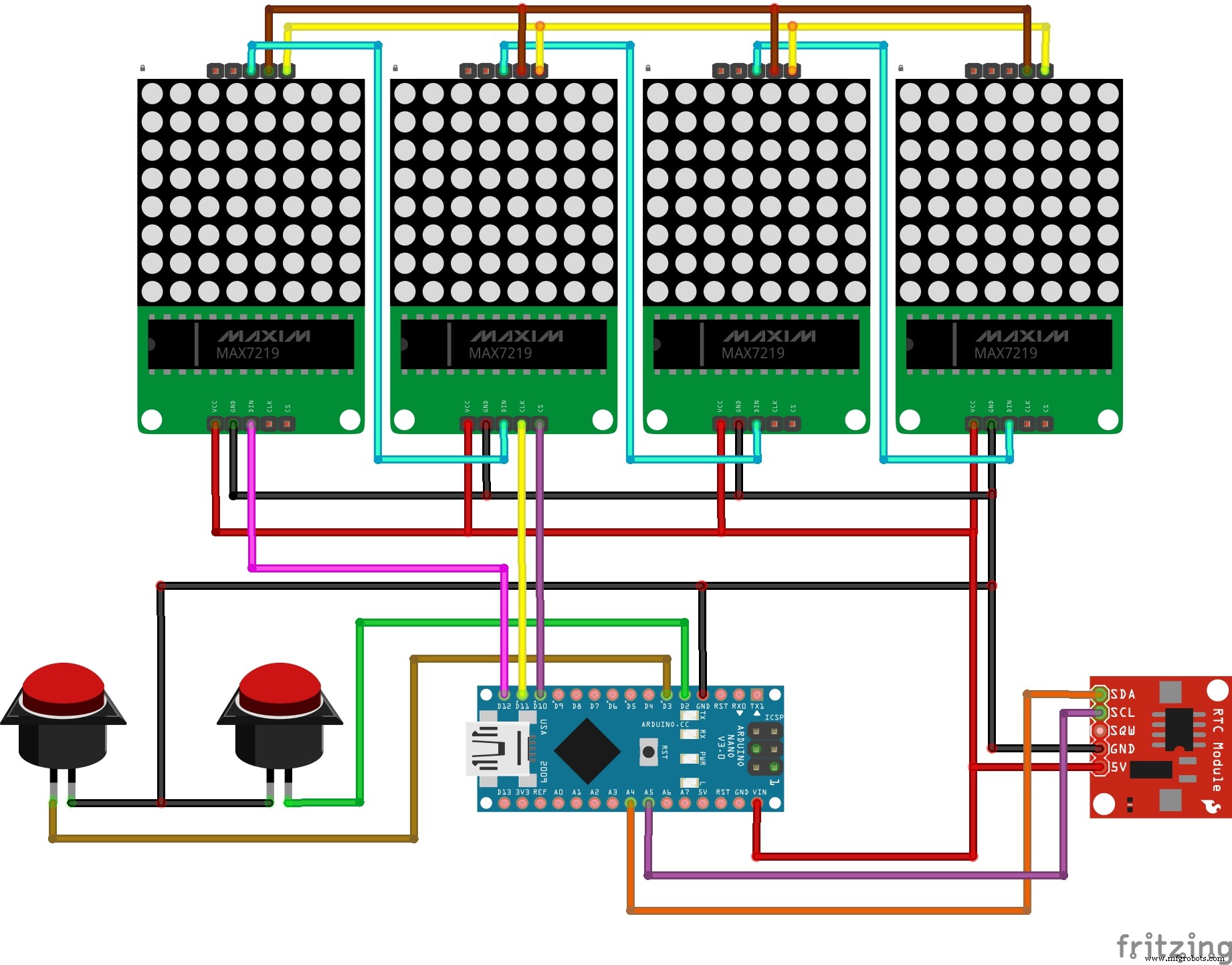
Como visto no circuito, além das matrizes precisamos de uma placa Arduino, um módulo relógio tempo real (RTC), e dois botões para configurações. Você pode baixar bibliotecas e código modificado nos links abaixo.
Código
Código
/***********************************************************************
Mini Clock v1.0, Jul 2014 by Nick Hall
Distribuído sob termos da GPL.
Para ajuda na construção veja meu blog: https://123led.wordpress.com/
Testado no IDE v1.6.5
***********************************************************************/
// Bibliotecas:
#include "LedControl.h"
#include <FontLEDClock.h> // Biblioteca de fontes
#include <Wire.h> // Relógio DS1307
#include "RTClib.h" // Relógio DS1307
#include <Button.h> // Biblioteca Button por Alexander Brevig

// Configuração Matriz LED
// pino 12 conectado ao DataIn no display
// pino 11 conectado ao CLK no display
// pino 10 conectado ao LOAD no display
LedControl lc = LedControl(12, 11, 10, 4); // define 3 pinos como 12, 11, 10 e 4 displays (máx 8)

// Variáveis globais
byte intensity = 7;        // Brilho padrão (0-15)
byte clock_mode = 0;       // Modo relógio padrão. 0 = basic_mode
bool random_mode = 0;      // Modo aleatório - muda tipo de exibição a cada poucas horas. Padrão 0 (desligado)
byte old_mode = clock_mode; // Armazena modo anterior, para saber qual voltar após data etc.
bool ampm = 0;             // Define 12 ou 24 horas. 0 = 24h. 1 = 12h
byte change_mode_time = 0; // Guarda hora quando modo mudará se no modo aleatório
unsigned long delaytime = 500; // Espera entre atualizações do display
int rtc[7];                // Guarda saída do RTC
char days[7][4] = { "Sun", "Mon", "Tue", "Wed", "Thu", "Fri", "Sat" };
char daysfull[7][9] = { "Sunday", "Monday", "Tuesday", "Wednesday", "Thursday", "Friday", "Saturday" };
char suffix[4][3] = { "st", "nd", "rd", "th" }; // sufixos de data

// Constantes
#define NUM_DISPLAY_MODES 3
#define NUM_SETTINGS_MODES 4
#define SLIDE_DELAY 20 // ms para efeito slide por caractere. Maior = mais lento
#define cls clear_display

RTC_DS1307 ds1307;
Button buttonA = Button(2, BUTTON_PULLUP);
Button buttonB = Button(3, BUTTON_PULLUP);

void setup() {
  digitalWrite(2, HIGH); // pullup botão pino 2
  digitalWrite(3, HIGH); // pullup botão pino 3
  digitalWrite(4, HIGH); // pullup botão pino 4
  Serial.begin(9600);

  // Inicializa 4 painéis de matriz
  int devices = lc.getDeviceCount();
  for (int address = 0; address < devices; address++) {
    lc.shutdown(address, false);
    lc.setIntensity(address, intensity);
    lc.clearDisplay(address);
  }

  // Setup DS1307 RTC
  #ifdef AVR
  Wire.begin();
  #else
  Wire1.begin(); // Shield I2C conecta a barramento I2C alternativo no Arduino
  #endif
  ds1307.begin();
  if (!ds1307.isrunning()) {
    Serial.println("RTC NÃO está rodando!");
    ds1307.adjust(DateTime(__DATE__, __TIME__));
  }
  printver();
  digitalWrite(13, HIGH); // LED vermelho ligado
}

void loop() {
  switch (clock_mode) {
    case 0: basic_mode(); break;
    case 1: small_mode(); break;
    case 2: slide(); break;
    case 3: word_clock(); break;
    case 4: setup_menu(); break;
  }
}

// Desenha ponto no display
void plot(byte x, byte y, byte val) {
  byte address;
  if (x >= 0 && x <= 7) { address = 3; }
  if (x >= 8 && x <= 15) { address = 2; x -= 8; }
  if (x >= 16 && x <= 23) { address = 1; x -= 16; }
  if (x >= 24 && x <= 31) { address = 0; x -= 24; }
  if (val == 1) { lc.setLed(address, y, x, true); }
  else { lc.setLed(address, y, x, false); }
}

void clear_display() {
  for (byte address = 0; address < 4; address++) { lc.clearDisplay(address); }
}

void fade_down() {
  for (byte i = intensity; i > 0; i--) {
    for (byte address = 0; address < 4; address++) { lc.setIntensity(address, i); }
    delay(30);
  }
  clear_display();
  for (byte address = 0; address < 4; address++) { lc.setIntensity(address, intensity); }
}

void printver() {
  byte i = 0;
  char ver_a[9] = "Vers 1.0";
  char ver_b[9] = " Hello! ";
  for (byte x = 0; x <= 31; x++) {
    for (byte y = 0; y <= 7; y++) { plot(x, y, 1); }
  }
  delay(500);
  fade_down();
  while (ver_a[i]) { puttinychar((i * 4), 1, ver_a[i]); delay(35); i++; }
  delay(700); fade_down();
  i = 0;
  while (ver_b[i]) { puttinychar((i * 4), 1, ver_b[i]); delay(35); i++; }
  delay(700); fade_down();
}

void puttinychar(byte x, byte y, char c) {
  byte dots;
  if (c >= 'A' && c <= 'Z' || (c >= 'a' && c <= 'z')) { c &= 0x1F; }
  else if (c >= '0' && c <= '9') { c = (c - '0') + 32; }
  else if (c == ' ') { c = 0; }
  else if (c == '.') { c = 27; }
  else if (c == ':') { c = 28; }
  else if (c == '\'') { c = 29; }
  else if (c == '!') { c = 30; }
  else if (c == '?') { c = 31; }
  for (byte col = 0; col < 3; col++) {
    dots = pgm_read_byte_near(&mytinyfont[c][col]);
    for (char row = 0; row < 5; row++) {
      if (dots & (16 >> row)) plot(x + col, y + row, 1);
      else plot(x + col, y + row, 0);
    }
  }
}

void putnormalchar(byte x, byte y, char c) {
  byte dots;
  if (c >= 'A' && c <= 'Z') { c &= 0x1F; }
  else if (c >= 'a' && c <= 'z') { c = (c - 'a') + 41; }
  else if (c >= '0' && c <= '9') { c = (c - '0') + 31; }
  else if (c == ' ') { c = 0; }
  else if (c == '.') { c = 27; }
  else if (c == '\'') { c = 28; }
  else if (c == ':') { c = 29; }
  else if (c == '>') { c = 30; }
  else if (c >= -80 && c <= -67) { c *= -1; }
  for (char col = 0; col < 5; col++) {
    dots = pgm_read_byte_near(&myfont[c][col]);
    for (char row = 0; row < 7; row++) {
      if (dots & (64 >> row)) plot(x + col, y + row, 1);
      else plot(x + col, y + row, 0);
    }
  }
}

void small_mode() {
  char textchar[8];
  byte mins = 100;
  byte secs = rtc[0];
  byte old_secs = secs;
  cls();
  while (run_mode()) {
    get_time();
    if (buttonA.uniquePress()) { switch_mode(); return; }
    if (buttonB.uniquePress()) { display_date(); return; }
    secs = rtc[0];
    if (secs != old_secs) {
      char buffer[3];
      itoa(secs, buffer, 10);
      if (secs < 10) { buffer[1] = buffer[0]; buffer[0] = '0'; }
      puttinychar(20, 1, ':');
      puttinychar(24, 1, buffer[0]);
      puttinychar(28, 1, buffer[1]);
      old_secs = secs;
    }
    if (mins != rtc[1]) {
      mins = rtc[1];
      byte hours = rtc[2];
      if (hours > 12) { hours -= ampm * 12; }
      if (hours < 1) { hours += ampm * 12; }
      char buffer[3];
      itoa(hours, buffer, 10);
      if (hours < 10) {
        buffer[1] = buffer[0];
        if (ampm) { buffer[0] = ' '; } else { buffer[0] = '0'; }
      }
      textchar[0] = buffer[0]; textchar[1] = buffer[1]; textchar[2] = ':';
      itoa(mins, buffer, 10);
      if (mins < 10) { buffer[1] = buffer[0]; buffer[0] = '0'; }
      textchar[3] = buffer[0]; textchar[4] = buffer[1];
      textchar[5] = ':'; buffer[3];
      secs = rtc[0];
      itoa(secs, buffer, 10);
      if (secs < 10) { buffer[1] = buffer[0]; buffer[0] = '0'; }
      textchar[6] = buffer[0]; textchar[7] = buffer[1];
      byte x = 0, y = 0;
      for (byte x = 0; x < 6; x++) { puttinychar(x * 4, 1, textchar[x]); }
    }
    delay(50);
  }
  fade_down();
}

void basic_mode() {
  cls();
  char buffer[3];
  byte offset = 0;
  byte x, y;
  byte hours = rtc[2];
  if (hours > 12) { hours -= ampm * 12; }
  if (hours < 1) { hours += ampm * 12; }
  byte secs = 100, mins = 100;
  int count = 0;
  while (run_mode()) {
    get_time();
    if (buttonA.uniquePress()) { switch_mode(); return; }
    if (buttonB.uniquePress()) { display_date(); return; }
    if (secs != rtc[0]) {
      secs = rtc[0];
      plot(15 - offset, 2, 1);
      plot(15 - offset, 5, 1);
      count = 400;
    }
    if (count == 0) {
      plot(15 - offset, 2, 0);
      plot(15 - offset, 5, 0);
    } else { count--; }
    if (mins != rtc[1]) {
      mins = rtc[1];
      hours = rtc[2];
      if (hours > 12) { hours -= ampm * 12; }
      if (hours < 1) { hours += ampm * 12; }
      itoa(hours, buffer, 10);
      if (hours < 10) {
        buffer[1] = buffer[0];
        if (ampm && hours < 10) { offset = 2; if (hours == 1 && mins == 0) cls(); }
        else { buffer[0] = '0'; }
      } else {
        offset = 0;
        if (hours == 10 && mins == 0) cls();
        putnormalchar(1, 0, buffer[0]);
      }
      putnormalchar(7 - offset, 0, buffer[1]);
      itoa(mins, buffer, 10);
      if (mins < 10) { buffer[1] = buffer[0]; buffer[0] = '0'; }
      putnormalchar(19 - offset, 0, buffer[0]);
      putnormalchar(25 - offset, 0, buffer[1]);
    }
  }
  fade_down();
}

void slide() {
  byte digits_old[4] = {99, 99, 99, 99};
  byte digits_new[4];
  byte digits_x_pos[4] = {25, 19, 7, 1};
  char old_char[2], new_char[2];
  cls();
  putnormalchar(13, 0, ':');
  byte old_secs = rtc[0];
  while (run_mode()) {
    get_time();
    if (buttonA.uniquePress()) { switch_mode(); return; }
    if (buttonB.uniquePress()) { display_date(); return; }
    if (rtc[0] != old_secs) {
      old_secs = rtc[0];
      byte hours = rtc[2];
      if (hours > 12) { hours -= ampm * 12; }
      if (hours < 1) { hours += ampm * 12; }
      digits_new[0] = (rtc[1] % 10);
      digits_new[1] = ((rtc[1] / 10) % 10);
      digits_new[2] = (hours % 10);
      digits_new[3] = ((hours / 10) % 10);
      for (byte i = 0; i <= 3; i++) {
        if (digits_old[i] != digits_new[i]) {
          for (byte seq = 0; seq <= 8; seq++) {
            itoa(digits_old[i], old_char, 10);
            itoa(digits_new[i], new_char, 10);
            if (ampm && i == 3) {
              if (digits_new[3] == 0) new_char[0] = ' ';
              if (digits_old[3] == 0) old_char[0] = ' ';
            }
            slideanim(digits_x_pos[i], 0, seq, old_char[0], new_char[0]);
            delay(SLIDE_DELAY);
          }
        }
      }
      for (byte i = 0; i <= 3; i++) { digits_old[i] = digits_new[i]; }
    }
  }
  fade_down();
}

void slideanim(byte x, byte y, byte sequence, char current_c, char new_c) {
  if (sequence < 7) {
    byte dots;
    if (current_c >= 'A' && current_c <= 'Z') { current_c &= 0x1F; }
    else if (current_c >= 'a' && current_c <= 'z') { current_c = (current_c - 'a') + 41; }
    else if (current_c >= '0' && current_c <= '9') { current_c = (current_c - '0') + 31; }
    else if (current_c == ' ') { current_c = 0; }
    else if (current_c == '.') { current_c = 27; }
    else if (current_c == '\'') { current_c = 28; }
    else if (current_c == ':') { current_c = 29; }
    else if (current_c == '>') { current_c = 30; }
    byte curr_char_row_max = 7 - sequence;
    byte start_y = sequence;
    for (byte curr_char_row = 0; curr_char_row <= curr_char_row_max; curr_char_row++) {
      for (byte col = 0; col < 5; col++) {
        dots = pgm_read_byte_near(&myfont[current_c][col]);
        if (dots & (64 >> curr_char_row)) plot(x + col, y + start_y, 1);
        else plot(x + col, y + start_y, 0);
      }
      start_y++;
    }
  }
  if (sequence >= 1 && sequence <= 8) {
    for (byte col = 0; col < 5; col++) { plot(x + col, y + (sequence - 1), 0); }
  }
  if (sequence >= 2) {
    byte dots;
    if (new_c >= 'A' && new_c <= 'Z') { new_c &= 0x1F; }
    else if (new_c >= 'a' && new_c <= 'z') { new_c = (new_c - 'a') + 41; }
    else if (new_c >= '0' && new_c <= '9') { new_c = (new_c - '0') + 31; }
    else if (new_c == ' ') { new_c = 0; }
    else if (new_c == '.') { new_c = 27; }
    else if (new_c == '\'') { new_c = 28; }
    else if (new_c == ':') { new_c = 29; }
    else if (new_c == '>') { new_c = 30; }
    byte newcharrowmin = 6 - (sequence - 2);
    byte start_y = 0;
    for (byte newcharrow = newcharrowmin; newcharrow <= 6; newcharrow++) {
      for (byte col = 0; col < 5; col++) {
        dots = pgm_read_byte_near(&myfont[new_c][col]);
        if (dots & (64 >> newcharrow)) plot(x + col, y + start_y, 1);
        else plot(x + col, y + start_y, 0);
      }
      start_y++;
    }
  }
}

void word_clock() {
  cls();
  char numbers[19][10] = { "one", "two", "three", "four", "five", "six", "seven", "eight", "nine", "ten", "eleven", "twelve", "thirteen", "fourteen", "fifteen", "sixteen", "seventeen", "eighteen", "nineteen" };
  char numberstens[5][7] = { "ten", "twenty", "thirty", "forty", "fifty" };
  char str_a[8], str_b[8], str_c[8];
  byte hours = rtc[2];
  if (hours > 12) { hours -= ampm * 12; }
  if (hours < 1) { hours += ampm * 12; }
  get_time();
  byte old_mins = 100;
  byte mins;
  while (run_mode()) {
    if (buttonA.uniquePress()) { switch_mode(); return; }
    if (buttonB.uniquePress()) { display_date(); }
    get_time();
    mins = rtc[1];
    if (mins != old_mins) {
      old_mins = mins;
      mins = rtc[1];
      hours = rtc[2];
      if (hours > 12) { hours -= 12; }
      if (hours == 0) { hours = 12; }
      int minsdigit = rtc[1] % 10;
      byte minsdigitten = (rtc[1] / 10) % 10;
      if (mins < 10) {
        strcpy(str_a, numbers[minsdigit - 1]);
        strcpy(str_b, "PAST");
        strcpy(str_c, numbers[hours - 1]);
      } else if (mins == 10) {
        strcpy(str_a, numbers[9]);
        strcpy(str_b, " PAST");
        strcpy(str_c, numbers[hours - 1]);
      } else if (minsdigitten != 0 && minsdigit != 0) {
        strcpy(str_a, numbers[hours - 1]);
        if (mins <= 19) { strcpy(str_b, numbers[mins - 1]); }
        else { strcpy(str_b, numberstens[minsdigitten - 1]); strcpy(str_c, numbers[minsdigit - 1]); }
      } else if (minsdigitten != 0 && minsdigit == 0) {
        strcpy(str_a, numbers[hours - 1]);
        strcpy(str_b, numberstens[minsdigitten - 1]);
        strcpy(str_c, "");
      } else if (minsdigitten == 0 && minsdigit == 0) {
        strcpy(str_a, numbers[hours - 1]);
        strcpy(str_b, "O'CLOCK");
        strcpy(str_c, "");
      }
      byte len = 0;
      while (str_a[len]) len++;
      byte offset_top = (31 - ((len - 1) * 4)) / 2;
      byte i = 0;
      while (str_a[i]) { puttinychar((i * 4) + offset_top, 1, str_a[i]); i++; }
      int counter = 1000;
      while (counter > 0) {
        if (buttonA.uniquePress()) { switch_mode(); return; }
        if (buttonB.uniquePress()) { display_date(); }
        delay(1); counter--;
      }
      fade_down();
      len = 0;
      while (str_b[len]) len++;
      offset_top = (31 - ((len - 1) * 4)) / 2;
      i = 0;
      while (str_b[i]) { puttinychar((i * 4) + offset_top, 1, str_b[i]); i++; }
      counter = 1000;
      while (counter > 0) {
        if (buttonA.uniquePress()) { switch_mode(); return; }
        if (buttonB.uniquePress()) { display_date(); }
        delay(1); counter--;
      }
      fade_down();
      len = 0;
      while (str_c[len]) len++;
      offset_top = (31 - ((len - 1) * 4)) / 2;
      i = 0;
      while (str_c[i]) { puttinychar((i * 4) + offset_top, 1, str_c[i]); i++; }
      counter = 1000;
      while (counter > 0) {
        if (buttonA.uniquePress()) { switch_mode(); return; }
        if (buttonB.uniquePress()) { display_date(); }
        delay(1); counter--;
      }
      fade_down();
      counter = 1000;
      while (counter > 0) {
        if (buttonA.uniquePress()) { switch_mode(); return; }
        if (buttonB.uniquePress()) { display_date(); }
        delay(1); counter--;
      }
    }
  }
  fade_down();
}

void scroll() {
  char message[] = { "Hello There " };
  cls();
  byte p = 6;
  byte chara[] = {0, 1, 2, 3, 4, 5};
  int x[] = {0, 6, 12, 18, 24, 30};
  byte y = 0;
  while (message[p] != '\0') {
    for (byte c = 0; c < 6; c++) {
      putnormalchar(x[c], y, message[chara[c]]);
      for (byte yy = 0; yy < 8; yy++) { plot(x[c] + 5, yy, 0); }
      x[c] = x[c] - 1;
    }
    for (byte i = 0; i <= 5; i++) {
      if (x[i] < -5) { x[i] = 31; chara[i] = p; p++; }
    }
  }
}

void display_date() {
  cls();
  byte dow = rtc[3];
  byte date = rtc[4];
  byte month = rtc[5] - 1;
  char monthnames[12][9] = { "January", "February", "March", "April", "May", "June", "July", "August", "Sept", "October", "November", "December" };
  byte len = 0;
  while (daysfull[dow][len]) len++;
  byte offset = (31 - ((len - 1) * 4)) / 2;
  int i = 0;
  while (daysfull[dow][i]) { puttinychar((i * 4) + offset, 1, daysfull[dow][i]); i++; }
  delay(1000); fade_down(); cls();
  char buffer[3];
  itoa(date, buffer, 10);
  offset = 10;
  byte s = 3;
  if (date == 1 || date == 21 || date == 31) s = 0;
  else if (date == 2 || date == 22) s = 1;
  else if (date == 3 || date == 23) s = 2;
  puttinychar(0 + offset, 1, buffer[0]);
  byte suffixposx = 4;
  if (date > 9) { suffixposx = 8; puttinychar(4 + offset, 1, buffer[1]); offset = 8; }
  puttinychar(suffixposx + offset, 1, suffix[s][0]);
  puttinychar(suffixposx + 4 + offset, 1, suffix[s][1]);
  delay(1000); fade_down();
  len = 0;
  while (monthnames[month][len]) len++;
  offset = (31 - ((len - 1) * 4)) / 2;
  i = 0;
  while (monthnames[month][i]) { puttinychar((i * 4) + offset, 1, monthnames[month][i]); i++; }
  delay(1000); fade_down();
}

void switch_mode() {
  old_mode = clock_mode;
  char* modes[] = { "Basic", "Small", "Slide", "Words", "Setup" };
  byte next_clock_mode;
  byte firstrun = 1;
  for (int count = 0; count < 35; count++) {
    if (buttonA.uniquePress() || firstrun == 1) {
      count = 0; cls();
      if (firstrun == 0) { clock_mode++; }
      if (clock_mode > NUM_DISPLAY_MODES + 1) { clock_mode = 0; }
      char str_top[9];
      strcpy(str_top, modes[clock_mode]);
      next_clock_mode = clock_mode + 1;
      if (next_clock_mode > NUM_DISPLAY_MODES + 1) { next_clock_mode = 0; }
      byte i = 0;
      while (str_top[i]) { putnormalchar(i * 6, 0, str_top[i]); i++; }
      firstrun = 0;
    }
    delay(50);
  }
}

byte run_mode() {
  if (random_mode) {
    if (change_mode_time == rtc[2]) {
      set_next_random();
      return 0;
    }
  }
  return 1;
}

void set_next_random() {
  get_time();
  change_mode_time = rtc[2] + random(1, 5);
  if (change_mode_time > 23) { change_mode_time = random(1, 4); }
  clock_mode = random(0, NUM_DISPLAY_MODES + 1);
}

void setup_menu() {
  char* set_modes[] = { "Random", "24 Hr", "Set", "Bright", "Exit" };
  if (ampm == 0) { set_modes[1] = "12 Hr"; }
  byte setting_mode = 0, next_setting_mode, firstrun = 1;
  for (int count = 0; count < 35; count++) {
    if (buttonA.uniquePress() || firstrun == 1) {
      count = 0; cls();
      if (firstrun == 0) { setting_mode++; }
      if (setting_mode > NUM_SETTINGS_MODES) { setting_mode = 0; }
      char str_top[9];
      strcpy(str_top, set_modes[setting_mode]);
      next_setting_mode = setting_mode + 1;
      if (next_setting_mode > NUM_SETTINGS_MODES) { next_setting_mode = 0; }
      byte i = 0;
      while (str_top[i]) { putnormalchar(i * 6, 0, str_top[i]); i++; }
      firstrun = 0;
    }
    delay(50);
  }
  switch (setting_mode) {
    case 0: set_random(); break;
    case 1: set_ampm(); break;
    case 2: set_time(); break;
    case 3: set_intensity(); break;
    case 4: break;
  }
  clock_mode = old_mode;
}

void set_random() {
  cls();
  char text_a[9] = "Off";
  char text_b[9] = "On";
  byte i = 0;
  if (random_mode) {
    random_mode = 0;
    while (text_a[i]) { putnormalchar((i * 6), 0, text_a[i]); i++; }
  } else {
    random_mode = 1;
    set_next_random();
    while (text_b[i]) { putnormalchar((i * 6), 0, text_b[i]); i++; }
  }
  delay(1500);
}

void set_ampm() {
  ampm = (ampm ^ 1);
  cls();
}

void set_intensity() {
  cls();
  byte i = 0;
  char text[7] = "Bright";
  while (text[i]) { puttinychar((i * 4) + 4, 0, text[i]); i++; }
  while (!buttonA.uniquePress()) {
    levelbar(0, 6, (intensity * 2) + 2, 2);
    while (buttonB.isPressed()) {
      if (intensity == 15) { intensity = 0; cls(); }
      else { intensity++; }
      i = 0;
      while (text[i]) { puttinychar((i * 4) + 4, 0, text[i]); i++; }
      levelbar(0, 6, (intensity * 2) + 2, 2);
      for (byte address = 0; address < 4; address++) { lc.setIntensity(address, intensity); }
      delay(150);
    }
  }
}

void levelbar(byte xpos, byte ypos, byte xbar, byte ybar) {
  for (byte x = 0; x < xbar; x++) {
    for (byte y = 0; y <= ybar; y++) { plot(x + xpos, y + ypos, 1); }
  }
}

void set_time() {
  cls();
  get_time();
  byte set_min = rtc[1];
  byte set_hr = rtc[2];
  byte set_date = rtc[4];
  byte set_mnth = rtc[5];
  int set_yr = rtc[6];
  set_date = set_value(2, set_date, 1, 31);
  set_mnth = set_value(3, set_mnth, 1, 12);
  set_yr = set_value(4, set_yr, 2013, 2099);
  set_hr = set_value(1, set_hr, 0, 23);
  set_min = set_value(0, set_min, 0, 59);
  ds1307.adjust(DateTime(set_yr, set_mnth, set_date, set_hr, set_min));
  cls();
}

int set_value(byte message, int current_value, int reset_value, int rollover_limit) {
  cls();
  char messages[6][17] = { "Set Mins", "Set Hour", "Set Day", "Set Mnth", "Set Year" };
  byte i = 0;
  while (messages[message][i]) { puttinychar(i * 4, 1, messages[message][i]); i++; }
  delay(2000); cls();
  char buffer[5] = " ";
  itoa(current_value, buffer, 10);
  puttinychar(0, 1, buffer[0]);
  puttinychar(4, 1, buffer[1]);
  puttinychar(8, 1, buffer[2]);
  puttinychar(12, 1, buffer[3]);
  delay(300);
  while (!buttonA.uniquePress()) {
    while (buttonB.isPressed()) {
      if (current_value < rollover_limit) { current_value++; }
      else { current_value = reset_value; }
      itoa(current_value, buffer, 10);
      puttinychar(0, 1, buffer[0]);
      puttinychar(4, 1, buffer[1]);
      puttinychar(8, 1, buffer[2]);
      puttinychar(12, 1, buffer[3]);
      delay(150);
    }
  }
  return current_value;
}

void get_time() {
  DateTime now = ds1307.now();
  rtc[6] = now.year();
  rtc[5] = now.month();
  rtc[4] = now.day();
  rtc[3] = now.dayOfWeek();
  rtc[2] = now.hour();
  rtc[1] = now.minute();
  rtc[0] = now.second();
}
Bibliotecas
Disponíveis para download (LedControl, FontLEDClock, RTClib, Button).
Esquemático
Processo de manufatura
- Construa um Sequenciador de LED com Timer 555 e Contador 4017 – Divisão de Frequência e Debounce
- Relógio Cuco: História, Artesanato e Evolução Moderna
- Domine Matrizes no MATLAB: Criação, Referência e Manipulação de Dados
- Jogo Arduino Mini Boss Battle – Projeto Inspirado em Retro Games
- Construa um Relógio Mestre LED Personalizado com Alarme – Visível a 12 Metros
- Construa um Relógio de Berlim com Arduino UNO – Relógio DIY de Matriz LED
- Relógio Analógico Estilo POV com LEDs – Projeto DIY Arduino Nano
- Display Interativo de Matriz LED na Porta com Sensor PIR – Saudação de Férias Arduino
- Display de Luz com 8 LEDs Ativado por Som
- Construa um Robô Quadrúpede Inteligente com Arduino: Guia Passo a Passo