



Modelo Arquitetônico de Ponto de Ônibus Inteligente com Toldo Automático
Componentes e Materiais
| Componente | Descrição | Qtd |
|---|---|---|
| Arduino Nano R3 | Pequeno, fácil de esconder no modelo. | 1 |
| Servo MG995 | Servo robusto (high torque) para toldo pesado. | 1 |
| Fotoresistor (LDR) | Um voltado para Leste, outro para Oeste. | 2 |
| Sensor de Chuva | – | 1 |
| LED Branco Alto Brilho | Iluminação interna e externa. | 6 |
| Resistor 220 Ω | Para LEDs. | 3 |
| Protoboard (genérica) | – | 1 |
| Jumpers Macho-Macho | – | 27 |
| Bloco de Terminais Parafuso | – | 2 |
| Conector Bateria 9V | – | 2 |
| Bateria 9V | – | 1 |
| Suporte 4xAA | Fonte externa para o MG995. | 1 |
Sobre o Projeto
Esta é uma atualização do projeto anterior (V1.0).
Principais mudanças da V1.0:
- Tamanho do modelo: 1,5 m x 1 m.
- Peso do toldo exigiu trocar o micro servo SG99 pelo MG995.
- Adicionada fonte de alimentação externa para o MG995.
- Testados dois mecanismos de expansão/contração do toldo. O descartado aparece no 2º vídeo; o definitivo no 3º.
- Sketch modificado para usar biblioteca VarSpeedServo (movimento suave).
- Corrigido pequeno erro lógico em um dos estados do toldo (obrigado Gurneet1928).
Versão 1.0: Model Version 1.0
Código
O Código (C/C++)
#include <VarSpeedServo.h>
VarSpeedServo servo;

int easternLight = 0;
int westernLight = 0;
int rainSensed = 0;
int sunshadePosition = 0;
int rainThreshold = 512;
int sunshadeExpanded = 120;
int sunshadeContracted = 60;
int ambientLighting = 0;
int turnOnLightsOn = 150;
int ledIntensity = 0;
int ledPower = 0;
int servoSpeed = 20;
bool debugging = false; // TRUE para debug no Serial

void setup() {
  pinMode(A4, OUTPUT); // Iluminação interna
  pinMode(A5, OUTPUT); // Luz externa (poste)
  pinMode(A1, INPUT);  // Luz oeste
  pinMode(A2, INPUT);  // Luz leste
  pinMode(A3, INPUT);  // Sensor chuva analógico
  pinMode(2, INPUT);   // Sensor chuva digital
  servo.attach(A0);
  servo.write(sunshadeContracted, servoSpeed, true);
  if (debugging) {
    Serial.begin(9600);
    Serial.println("*** DEBUGGING STARTED ***");
    Serial.println("-------------------------");
  }
}

void oya_mydebug(String text, int value = NULL) {
  if (debugging) {
    Serial.print(text);
    if (value) { Serial.print(" = "); Serial.println(value); }
    else { Serial.println(" "); }
  }
}

void expand_collapse(int easternLight, int westernLight) {
  if (easternLight <= westernLight) { // Nascer do sol
    oya_mydebug("It's sunrise");
    if (sunshadePosition != sunshadeExpanded) {
      servo.write(sunshadeExpanded, servoSpeed, true);
      oya_mydebug("Sunshade expanded");
    }
  }
  if (easternLight > westernLight) { // Pôr do sol
    oya_mydebug("Sun is going down");
    if (sunshadePosition != sunshadeContracted) {
      servo.write(sunshadeContracted, servoSpeed, true);
      oya_mydebug("Sunshade contracted");
    }
  }
}

void loop() {
  easternLight = analogRead(A2);
  westernLight = analogRead(A1);
  rainSensed = analogRead(A3);
  sunshadePosition = servo.read();
  ambientLighting = (easternLight + westernLight) / 2; // média

  oya_mydebug("easternLight", easternLight);
  oya_mydebug("westernLight", westernLight);
  oya_mydebug("rainSensed", rainSensed);
  oya_mydebug("sunshadePosition", sunshadePosition);
  oya_mydebug("ambientLighting", ambientLighting);

  // Chovendo?
  if (rainSensed < rainThreshold) {
    oya_mydebug("It's raining...");
    if (sunshadePosition != sunshadeExpanded) {
      servo.write(sunshadeExpanded, servoSpeed, true);
      oya_mydebug("Sunshade expanded");
    }
  } else {
    oya_mydebug("It is not raining...");
    if (ambientLighting <= turnOnLightsOn) { // Escurecendo
      oya_mydebug("It's getting dark, turning on lights");
      ledPower = (turnOnLightsOn - ambientLighting) * 4;
      oya_mydebug("ledPower", ledPower);
      analogWrite(A5, ledPower);
      analogWrite(A4, ledPower);
      expand_collapse(easternLight, westernLight);
    } else { // Muito sol
      oya_mydebug("A lot of sunshine, turn off lights");
      analogWrite(A5, 0);
      analogWrite(A4, 0);
      expand_collapse(easternLight, westernLight);
    }
  }

  if (debugging) {
    Serial.println("********************");
    Serial.println(" ");
    delay(5000);
  } else {
    delay(100);
  }
}
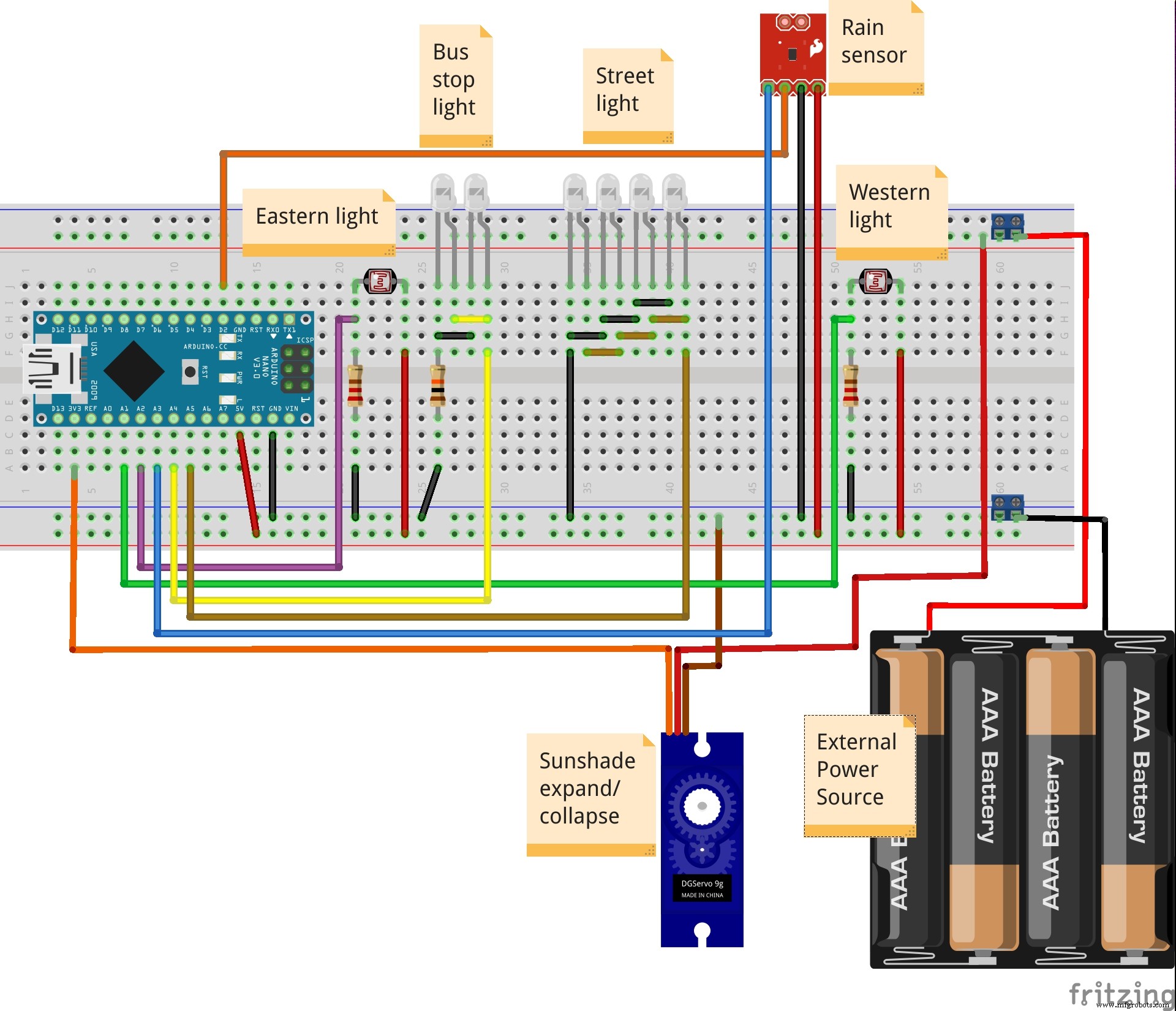
Esquemático
START: Terminal Arduino Autônomo com Teclado PS2, LCD, Ethernet e Acesso Shell Remoto
Sistema Inteligente de Ventilação de Porão: Controle de Umidade com Arduino
Processo de manufatura
- Trens Lionel: História, Fabricação e Futuro
- Robô de Triagem de Reciclagem Alimentado por Google Coral Edge TPU
- Maximize Receita Recorrente com Consumíveis Inteligentes: Um Divisor de Águas para Fabricantes de Máquinas
- Controle Automático de Trem DIY com Arduino – Simples, Confiável e Personalizável
- Robô Desviador de Obstáculos com Servo: Construa com Arduino e HC-SR04
- Torno Linear SPRINT 20: Torneamento Automatizado Rápido para Peças de Alta Precisão
- Fundamentos da Prensa Servo: Potência, Precisão e Eficiência Explicadas
- Motores Servo Explicados: Como Funcionam e Por Que Importam
- Maximizando Precisão: Combinando Redutores com Servomotores
- Ciclo de Furação ECS G86 com Recurso de Parada do Fuso