



Construa um Jogo Arcade Clássico com Arduino, LCD, Buzzer e Joystick
Componentes e Materiais
| Placa de ensaio (genérica) | 1 |
| Fios jumpers (genéricos) | 1 |
| Arduino UNO | 1 |
| Cabo USB-A para B | 1 |
| Potenciômetro rotativo (genérico) | 1 |
| Joystick analógico (genérico) | 1 |
| Buzzer | 1 |
| Display LCD padrão Adafruit - 16x2 Branco sobre Azul | 1 |
Aplicativos e Serviços Online
- Arduino IDE
Sobre o Projeto
Este projeto baseia-se em um jogo de vídeo encontrado na internet. Ele possui diversos recursos, como um buzzer que emite sons quando o personagem colide ou pula obstáculos. Para dar a sensação de um videogame real, utiliza-se um joystick (que deve ter um botão), pois basta pressionar o botão do joystick para pular. O jogo consiste em um homem correndo e pulando obstáculos, evitando-os. O objetivo é obter o máximo de pontos possível (um ponto para cada segundo que você permanece no percurso desviando dos obstáculos).
Código
O código completo está disponível abaixo. Ele utiliza a biblioteca LiquidCrystal.h para controlar o display LCD e define diversos sprites personalizados para o herói, terreno e obstáculos. O jogo inclui detecção de colisão, geração de terreno aleatório, controle de pulo via interrupção do botão do joystick e feedback sonoro pelo buzzer.
#include <LiquidCrystal.h>
#define PIN_BUTTON 2
#define PIN_AUTOPLAY 1
#define PIN_BUZZER 8
#define PIN_READWRITE 10
#define PIN_CONTRAST 12
#define SPRITE_RUN1 1
#define SPRITE_RUN2 2
#define SPRITE_JUMP 3
#define SPRITE_JUMP_UPPER '.'
#define SPRITE_JUMP_LOWER 4
#define SPRITE_TERRAIN_EMPTY ' '
#define SPRITE_TERRAIN_SOLID 5
#define SPRITE_TERRAIN_SOLID_RIGHT 6
#define SPRITE_TERRAIN_SOLID_LEFT 7
#define HERO_HORIZONTAL_POSITION 1
#define TERRAIN_WIDTH 16
#define TERRAIN_EMPTY 0
#define TERRAIN_LOWER_BLOCK 1
#define TERRAIN_UPPER_BLOCK 2
#define HERO_POSITION_OFF 0
#define HERO_POSITION_RUN_LOWER_1 1
#define HERO_POSITION_RUN_LOWER_2 2
#define HERO_POSITION_JUMP_1 3
#define HERO_POSITION_JUMP_2 4
#define HERO_POSITION_JUMP_3 5
#define HERO_POSITION_JUMP_4 6
#define HERO_POSITION_JUMP_5 7
#define HERO_POSITION_JUMP_6 8
#define HERO_POSITION_JUMP_7 9
#define HERO_POSITION_JUMP_8 10
#define HERO_POSITION_RUN_UPPER_1 11
#define HERO_POSITION_RUN_UPPER_2 12

LiquidCrystal lcd(11, 9, 6, 5, 4, 3);
static char terrainUpper[TERRAIN_WIDTH + 1];
static char terrainLower[TERRAIN_WIDTH + 1];
static bool buttonPushed = false;

void initializeGraphics() {
  static byte graphics[] = {
    // Posição de corrida 1
    B01100, B01100, B00000, B01110, B11100, B01100, B11010, B10011,
    // Posição de corrida 2
    B01100, B01100, B00000, B01100, B01100, B01100, B01100, B01110,
    // Pulo
    B01100, B01100, B00000, B11110, B01101, B11111, B10000, B00000,
    // Pulo inferior
    B11110, B01101, B11111, B10000, B00000, B00000, B00000, B00000,
    // Chão
    B11111, B11111, B11111, B11111, B11111, B11111, B11111, B11111,
    // Chão direito
    B00011, B00011, B00011, B00011, B00011, B00011, B00011, B00011,
    // Chão esquerdo
    B11000, B11000, B11000, B11000, B11000, B11000, B11000, B11000,
  };
  for (int i = 0; i < 7; ++i) {
    lcd.createChar(i + 1, &graphics[i * 8]);
  }
  for (int i = 0; i < TERRAIN_WIDTH; ++i) {
    terrainUpper[i] = SPRITE_TERRAIN_EMPTY;
    terrainLower[i] = SPRITE_TERRAIN_EMPTY;
  }
}

void advanceTerrain(char* terrain, byte newTerrain) {
  for (int i = 0; i < TERRAIN_WIDTH; ++i) {
    char current = terrain[i];
    char next = (i == TERRAIN_WIDTH - 1) ? newTerrain : terrain[i + 1];
    switch (current) {
      case SPRITE_TERRAIN_EMPTY:
        terrain[i] = (next == SPRITE_TERRAIN_SOLID) ? SPRITE_TERRAIN_SOLID_RIGHT : SPRITE_TERRAIN_EMPTY;
        break;
      case SPRITE_TERRAIN_SOLID:
        terrain[i] = (next == SPRITE_TERRAIN_EMPTY) ? SPRITE_TERRAIN_SOLID_LEFT : SPRITE_TERRAIN_SOLID;
        break;
      case SPRITE_TERRAIN_SOLID_RIGHT:
        terrain[i] = SPRITE_TERRAIN_SOLID;
        break;
      case SPRITE_TERRAIN_SOLID_LEFT:
        terrain[i] = SPRITE_TERRAIN_EMPTY;
        break;
    }
  }
}

bool drawHero(byte position, char* terrainUpper, char* terrainLower, unsigned int score) {
  bool collide = false;
  char upperSave = terrainUpper[HERO_HORIZONTAL_POSITION];
  char lowerSave = terrainLower[HERO_HORIZONTAL_POSITION];
  byte upper, lower;
  switch (position) {
    case HERO_POSITION_OFF:
      upper = lower = SPRITE_TERRAIN_EMPTY;
      break;
    case HERO_POSITION_RUN_LOWER_1:
      upper = SPRITE_TERRAIN_EMPTY; lower = SPRITE_RUN1;
      break;
    case HERO_POSITION_RUN_LOWER_2:
      upper = SPRITE_TERRAIN_EMPTY; lower = SPRITE_RUN2;
      break;
    case HERO_POSITION_JUMP_1:
    case HERO_POSITION_JUMP_8:
      upper = SPRITE_TERRAIN_EMPTY; lower = SPRITE_JUMP;
      break;
    case HERO_POSITION_JUMP_2:
    case HERO_POSITION_JUMP_7:
      upper = SPRITE_JUMP_UPPER; lower = SPRITE_JUMP_LOWER;
      break;
    case HERO_POSITION_JUMP_3:
    case HERO_POSITION_JUMP_4:
    case HERO_POSITION_JUMP_5:
    case HERO_POSITION_JUMP_6:
      upper = SPRITE_JUMP; lower = SPRITE_TERRAIN_EMPTY;
      break;
    case HERO_POSITION_RUN_UPPER_1:
      upper = SPRITE_RUN1; lower = SPRITE_TERRAIN_EMPTY;
      break;
    case HERO_POSITION_RUN_UPPER_2:
      upper = SPRITE_RUN2; lower = SPRITE_TERRAIN_EMPTY;
      break;
  }
  if (upper != ' ') {
    terrainUpper[HERO_HORIZONTAL_POSITION] = upper;
    collide = (upperSave == SPRITE_TERRAIN_EMPTY) ? false : true;
  }
  if (lower != ' ') {
    terrainLower[HERO_HORIZONTAL_POSITION] = lower;
    collide |= (lowerSave == SPRITE_TERRAIN_EMPTY) ? false : true;
  }
  byte digits = (score > 9999) ? 5 : (score > 999) ? 4 : (score > 99) ? 3 : (score > 9) ? 2 : 1;
  terrainUpper[TERRAIN_WIDTH] = '\0';
  terrainLower[TERRAIN_WIDTH] = '\0';
  char temp = terrainUpper[16 - digits];
  terrainUpper[16 - digits] = '\0';
  lcd.setCursor(0, 0);
  lcd.print(terrainUpper);
  terrainUpper[16 - digits] = temp;
  lcd.setCursor(0, 1);
  lcd.print(terrainLower);
  lcd.setCursor(16 - digits, 0);
  lcd.print(score);
  terrainUpper[HERO_HORIZONTAL_POSITION] = upperSave;
  terrainLower[HERO_HORIZONTAL_POSITION] = lowerSave;
  return collide;
}

void buttonPush() {
  buttonPushed = true;
}

void setup() {
  pinMode(PIN_READWRITE, OUTPUT);
  digitalWrite(PIN_READWRITE, LOW);
  pinMode(PIN_CONTRAST, OUTPUT);
  digitalWrite(PIN_CONTRAST, LOW);
  pinMode(PIN_BUTTON, INPUT);
  digitalWrite(PIN_BUTTON, HIGH);
  pinMode(PIN_AUTOPLAY, OUTPUT);
  digitalWrite(PIN_AUTOPLAY, HIGH);
  pinMode(PIN_BUZZER, OUTPUT);
  digitalWrite(PIN_BUZZER, LOW);
  attachInterrupt(0, buttonPush, FALLING);
  initializeGraphics();
  lcd.begin(16, 2);
}

void loop() {
  static byte heroPos = HERO_POSITION_RUN_LOWER_1;
  static byte newTerrainType = TERRAIN_EMPTY;
  static byte newTerrainDuration = 1;
  static bool playing = false;
  static bool blink = false;
  static unsigned int distance = 0;

  if (!playing) {
    drawHero(blink ? HERO_POSITION_OFF : heroPos, terrainUpper, terrainLower, distance >> 3);
    if (blink) {
      lcd.setCursor(0, 0);
      lcd.print("Pressione Start");
    }
    delay(250);
    blink = !blink;
    if (buttonPushed) {
      initializeGraphics();
      heroPos = HERO_POSITION_RUN_LOWER_1;
      playing = true;
      buttonPushed = false;
      distance = 0;
    }
    return;
  }

  advanceTerrain(terrainLower, newTerrainType == TERRAIN_LOWER_BLOCK ? SPRITE_TERRAIN_SOLID : SPRITE_TERRAIN_EMPTY);
  advanceTerrain(terrainUpper, newTerrainType == TERRAIN_UPPER_BLOCK ? SPRITE_TERRAIN_SOLID : SPRITE_TERRAIN_EMPTY);

  if (--newTerrainDuration == 0) {
    if (newTerrainType == TERRAIN_EMPTY) {
      newTerrainType = (random(3) == 0) ? TERRAIN_UPPER_BLOCK : TERRAIN_LOWER_BLOCK;
      newTerrainDuration = 2 + random(10);
    } else {
      newTerrainType = TERRAIN_EMPTY;
      newTerrainDuration = 10 + random(10);
    }
  }

  if (buttonPushed) {
    if (heroPos <= HERO_POSITION_RUN_LOWER_2) heroPos = HERO_POSITION_JUMP_1;
    buttonPushed = false;
    digitalWrite(PIN_BUZZER, HIGH);
  }

  if (drawHero(heroPos, terrainUpper, terrainLower, distance >> 3)) {
    playing = false;
    for (int i = 0; i <= 2; i++) {
      digitalWrite(PIN_BUZZER, HIGH);
      delay(100);
      digitalWrite(PIN_BUZZER, LOW);
      delay(100);
    }
  } else {
    if (heroPos == HERO_POSITION_RUN_LOWER_2 || heroPos == HERO_POSITION_JUMP_8) {
      heroPos = HERO_POSITION_RUN_LOWER_1;
    } else if ((heroPos >= HERO_POSITION_JUMP_3 && heroPos <= HERO_POSITION_JUMP_5) && terrainLower[HERO_HORIZONTAL_POSITION] != SPRITE_TERRAIN_EMPTY) {
      heroPos = HERO_POSITION_RUN_UPPER_1;
    } else if (heroPos >= HERO_POSITION_RUN_UPPER_1 && terrainLower[HERO_HORIZONTAL_POSITION] == SPRITE_TERRAIN_EMPTY) {
      heroPos = HERO_POSITION_JUMP_5;
    } else if (heroPos == HERO_POSITION_RUN_UPPER_2) {
      heroPos = HERO_POSITION_RUN_UPPER_1;
    } else {
      ++heroPos;
    }
    ++distance;
    digitalWrite(PIN_AUTOPLAY, terrainLower[HERO_HORIZONTAL_POSITION + 2] == SPRITE_TERRAIN_EMPTY ? HIGH : LOW);
  }
  delay(100);
  digitalWrite(PIN_BUZZER, LOW);
}
Esquemáticos
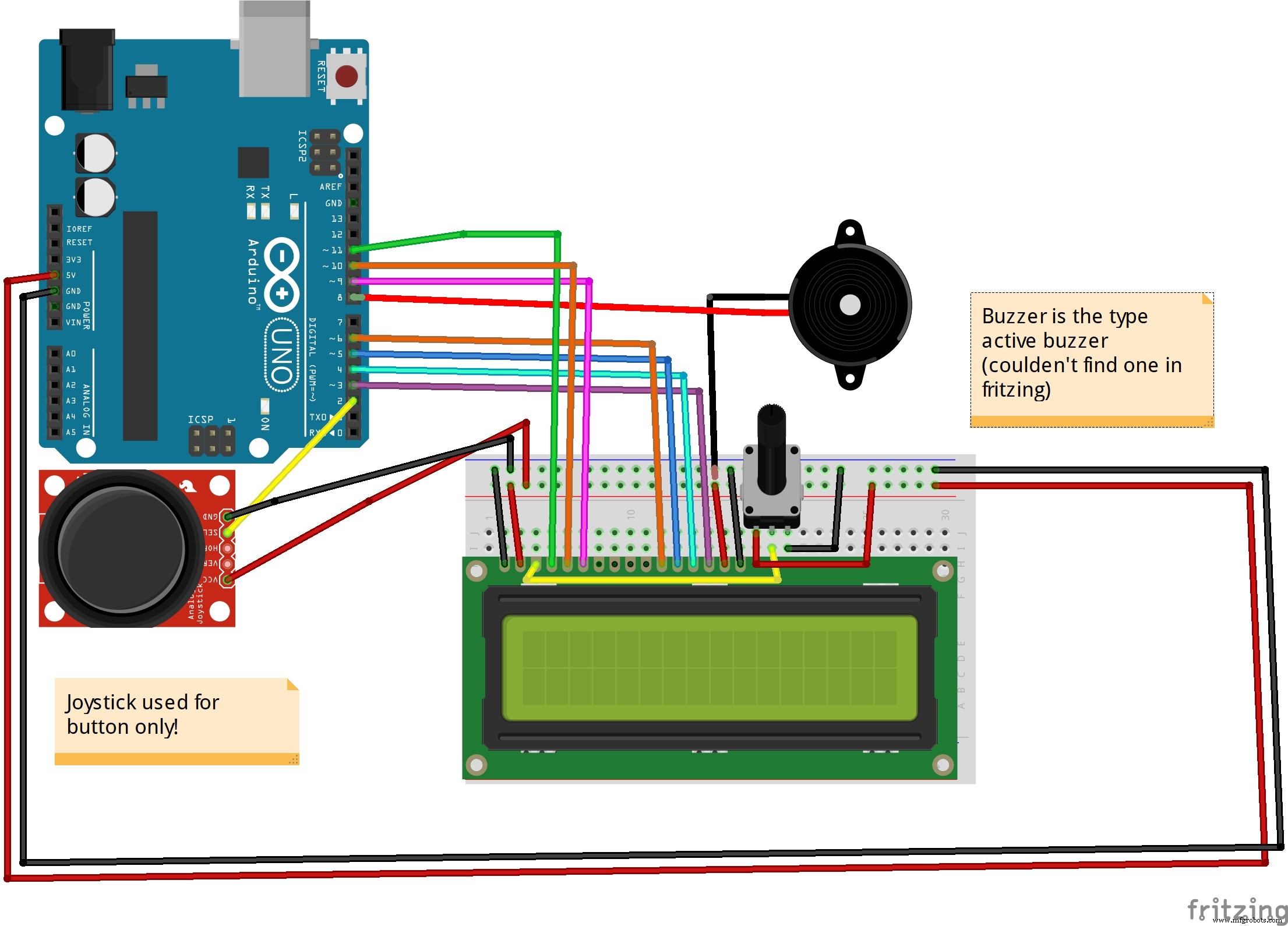
O esquema mostra como conectar todos os componentes. A imagem ilustra a ligação do display LCD, joystick, buzzer e potenciômetro ao Arduino UNO.
Processo de manufatura
- Detector de Idiomas TinyML com Edge Impulse no Arduino Nano 33 BLE Sense
- Construa um Jogo em Tempo Real com Giroscópio: Arduino Nano + Sensor MPU-6050
- Dados Digital com Arduino: Gere Números Aleatórios 1-6 em LCD 16x2
- Construa Seu Próprio Jogo de Roleta com 37 LEDs e Arduino Nano
- Controle USB para Jogos DIY com Arduino – Construa Seu Próprio Gamepad de Alto Desempenho
- Jogo Interativo com Joystick e Arduino – Feedback com LEDs
- Find Me: Localizador Inteligente de Objetos com Arduino e Bluetooth
- Pixel Chaser: Jogo LED Interativo de Um Toque com Arduino Nano
- Osciloscópio DIY com Arduino Nano (10 Hz–50 kHz) e LCD 128×64
- Lâmpada de Mesa Reativa a Áudio com Arduino Nano